Showing posts with label how to. Show all posts

How to tie a White Zonker Streamer Fly

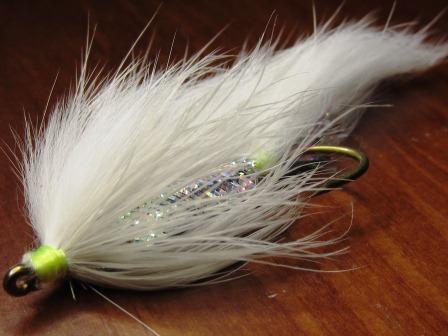
The Zonker Fly has been around for a long time. This deadly Streamer Pattern has caught many fish over the years and I can imagine it will remain a top fly for the rest of time. Casting a white streamer is like casting a "Tracer Fly", you can watch the fish chase it down and wolf it. This White Zonker is tied with lead wire to make it heavier, but I have tied this fly many ways with great success.


Watch how to tie this fly:

~ Click on any image to enlarge ~

Materials List:

Zonker flies always get bites and it makes sense to use a strong streamer hook that can take the action. For this fly used a size #2 long shank streamer hook with a straight eye.

Click here to buy strong Streamer Hooks


I used Lead Wire to add weight to this fly.


Be sure to use strong fly tying thread for this streamer pattern.


The belly of this fly is tied with mylar tubing.  I have experimented with many sizes and colors and all of them get the bite.


The tail and body of this Streamer Pattern are tied with a single strip of white rabbit.


Finally, the Collar of this White Zonker is tied with a webby white hackle.  I suggest using Schlappen.
Click here to buy White Schlappen Hackles


~ Click on any image to enlarge ~


Step By Step: How to tie a White Zonker Streamer Fly 

Start a streamer hook with lead wire.
Use strong thread.
Surround the hook with mylar tubing and tie it off.  Leave a little material off of the back of the hook to add flash to the fly.
Add a strip of white rabbit fur. tie in the middle of the strip.  After you tie off the rabbit,whip finish at this point and cut the thread.
Restart the thread at the eye of the hook.  This will tie off the mylar tubing, be sure to trim it closely.
Finally, add a number of turns of webby white hackle for the collar of the fly.  Next pull the rabbit strip forward over the hackle and tie it off at the eye. Complete this fly with a few tight whip finishes.

White Zonker Fly


Fly fishing with streamers is one of the most fun things you can do. You will have trouble finding better fishing than on the Roaring Fork River and Colorado River.  Consider booking a guided fishing trip on your vacation to the Colorado Rockies, you will be impressed.  Go to http://www.aspenflyfishing.com


How to tie a
White Zonker Streamer Fly

How to tie an H & L Variant Dry Fly


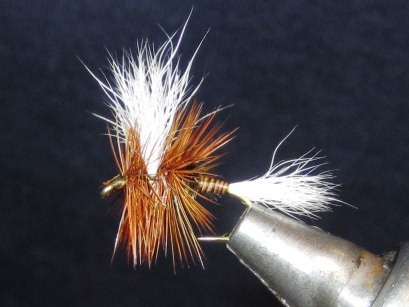
The H and L Variant is one of the great dry fly attractor patterns. This highly visible dry fly floats well, can be seen well in low light conditions and trout eat the heck out of it.  I like to use a size #10, #12, or #14 when tying this fly. I find that an H and L works best in fast rivers when there are lots of caddis and mayflies hatching, or anywhere on the Frying Pan River.


Watch how to tie this fly:

~ Click on any image to enlarge ~

Materials List:

You can expect this H&L to get lots of bites.  I suggest using a strong dry fly hook that won't bend out.


I like to use a thread that is strong, but not too bulky when I tie hair wing dry flies like this one.  Danville's FlyMaster is a good choice.


The wings of this dry fly pattern are tied with Calf Body Fur.  This material is very visible even in low light situations.


Both the body and the collar of this fly are tied with peacokc hurl.


Finally, the hackle of an H & L Variant is tied with a couple of stout brown saddle hackles.
Click here to buy Brown Saddle Hackles


~ Click on any image to enlarge ~

Step By Step: How to tie an H and L Variant Dry Fly

Set a strong dry fly hook in the vise.
Start the hook with thread and leave it at the midpoint of the shank.
Stack the tips of a clump of calf body fur and tie them in, tips forward for the wing of the fly.
Now part the calf body fur and separate the wings with thread. I use a figure 8 wrap and often a few wraps around each wing. Be sure not to use too much thread. Here is a view from the top of the top.
Tie in the tail of the fly by stacking another clump of calf body fur.
The body of this fly is tied by stripping a peacock hurl and wrapping it forward about 1/3rd of the way to the eye.
Next, wrap two or three turns of regular peacock hurl for the collar of the fly.
Finally, tie in two stout brown saddle hackles. Wrap the hackles both in front and behind the wings and complete the fly with a few tight whip finishes.

H and L Variant Dry Fly


Dry Fly fishing in Colorado is fantastic, especially around the Aspen area.  The rivers here are full of hungry trout that love to eat dries.  The best time of year to catch fish on dry flies is July, August and September.  If you would like to experience what dry fly fishing should be, go to http://www.aspenflyfishing.com and book a guided float trip.


How to tie an
H and L Variant Dry Fly

How to tie a Bead Head Prince Nymph


The Prince Nymph is the most popular nymph I know, add a Bead Head to this fly and trout beware.  This best in class Bead Head Nymph Pattern can be tied in many sizes, but this fly works best in size #12, #14 and #16.  The best time to use the Bead Head Prince Nymph, is right when you get to the water.


Watch how to tie this fly:

~ Click on any image to enlarge ~

Materials List:

Very few fish can resist a Prince Nymph drifting buy. I suggest using a strong nymph hook like a Tiemco 3761.  This fly can be tied in many sizes, the most popular are #10, #12, #14, and #16.
Click here to buy strong Nymph Hooks


What would a Bead Head Prince Nymph be without a bead?! For this particular fly is chose to use a small copper bead.
Click here to buy Fly Tying Beads


This particular pattern is weighted with lead wire.  This helps give the fly a "full" body look.
Click here to buy Small Lead Wire


This nymph pattern is going to take some abuse.  I suggest using strong thread that you can wrap tightly.
Click here to buy strong Fly Tying Thread


The rib of this fly is tied with copper wire. I have use many colors for the rib of this pattern and found that they all work.


The body of this nymph pattern is tied with a couple strands of peacock hurl.


The tail of this Prince Nymph Pattern is tied with brown goose biots.


The wing of this fly is tied with white goose biots.


Finally, the hackle of this fly is tied with brown saddle hackle.


~ Click on any image to enlarge. ~

Step By Step: How to tie a Bead Head Prince Nymph

Start a strong nymph hook with a bead, small lead wire and thread.
Add two brown goose biots, splayed out, for the tail of the fly.
Tie in a stretch of copper wire for the rib of the fly.
Now add a few strands of peacock hurl for the body.
Wrap the peacock forward to the bead.
Counter wrap the copper wire over the peacock and up to the bead.
Add a few turns of saddle hackle.
Now, mash the hackle on the top of the hook out to the sides to prepare a space for the biot wing of the fly.
Finally, add the biot wing, curved downward, and complete the fly with a few tight whip finishes.

Bead Head Prince Nymph


Bead Head Prince Nymphs work well in the Colorado Rockies, especially on the Roaring Fork River and Colorado River.  I use this fly throughout the season and consider it a standard for catching many trout.  If you would like to take a guided float trip on one of the rivers mentioned here, contact http://www.aspenflyfishing.com and get your catch on!


"How to tie a
Bead Head Prince Nymph"