Showing posts with label adult. Show all posts

How to tie an Adult Midge Nymph


Midge Patterns like this Adult Midge Nymph are the best flies to use during a Colorado Winter.  This little bug exists everywhere and trout have to eat them to survive in the icy cold water. This particular midge pattern is tied to imitate a midge that has been washed under.

~ Click here to learn a little more about Midges ~


Watch how to tie this fly:

~ Click on any image to enlarge ~

Materials List:

This Adult Midge Pattern is tied with a size #20 Tiemco 3761. I have used many different hooks for this fly and all of them work.


The body of this fly is strengthened with a tinsel rib.  I suppose you can use any color that you like for the rib of this fly, however the wire you use must be x-small or fine.


The head of this fly is tied with a small amount of black dubbing. I have used a few other dark colors without giving up strikes.


 I happened to use this mylar braid product for the wing of the fly in this video.  I have used many other forms of flash for the with of this Adult Midge Nymph with great success.


~ Click on any image to enlarge ~


Step by Step Instructions: How to tie an Adult Midge Nymph


Start a small hook with black thread
Add a stretch of fine gold tinsel
Wrap the thread back to the top of the bend over the tinsel.  You may want to build up the body with one or two extra passes up and down the shank of the hook with the thread.
Now counter wrap the tinsel forward over the thread body
Tie in a wing with flash or some other white material
Finish the fly with a small amount of dubbing and a whip finish.

Adult Midge Nymph


Adult Midge Nymphs work very well on the Roaring Fork River in the Winter and early Spring months. If you would like to get out and do some incredible fly fishing, even in the Winter, go to http://www.aspenflyfishing.com


"How to tie an
Adult Midge Nymph"


How to tie an Elk Hair Caddis


This Elk Hair Caddis Pattern is the best caddis dry fly I know. It floats, you can see it, you can skitter it, it is durable and the trout eat it as soon as they see it. Caddis flies hatch throughout the Spring, Summer and Fall and are one of the most important food sources for growing trout.  This particular dry fly pattern is perhaps the only caddis dry fly you need.

~ Click here to learn a little more about Caddis Flies ~


Watch how to tie this Dry Fly:


~ Click on any image to enlarge ~

Materials List:

Caddis Dries like this one should be tied on a strong hook that can take many bites.  I prefer a Tiemco 3761 size #12, #14 or #16


Using strong thread is a must when you tie flies with spun hair.  I have used all different colors of thread and the fish still bite this fly.


What would an Elk Hair Caddis be without Elk Hair?!


Finally, i like to use brown saddle hackle for this dry fly. However, I have used a combo of grizzly and brown hackles with great success.
Click here to buy Brown Saddle Hackles


~ Click on any image to enlarge ~


Step By Step: How to tie an Elk Hair Caddis


Start a strong hook with strong thread
Now stack a good clump of Elk Hair


Tie in the clump of elk hair for the wing. wrap the thread through the hair all the way forward


Finally, tie in two stout brown saddle hackles and tie off the fly.


Elk Hair Caddis Fly
The dry fly fishing on the Roaring Fork River near Aspen, Colorado, is the best dry fly fishing in the state.  Float trips on the Roaring Fork range from Upper Woody Creek down to Glenwood Springs.  If pitching little caddis dries up to the bank and catching all kinds of fish is your game, you need to fish here. Go to http://www.aspenflyfishing.com for booking and information.


"How to tie the best
Elk Hair Caddis"


How to tie a #20 Adams Dry Fly


The Adam's Dry Fly is a great imitation of almost every adult mayfly. This well known pattern is a must for serious anglers in every mayfly hatch. My father always told me, "No brown trout in the world can resist a Size 20 Adam's..."


Watch how to tie this fly:


~ Click on any image to enlarge ~

Materials List:

If it is true that no brown trout can resist a #20 Adam's, then you better get a strong #20 hook.


I use some shade of gray when I tie this dry fly pattern. I have experimented with different colored threads, like yellow and olive, and they still eat it.


 The Adam's Dry Fly uses brown hackle in the tail and the hackle of the fly. I like to use saddle hackle because the feathers are dense and stout.


This little dry fly also uses grizzly hackle, combined with brown in the tail and hackle of the fly. Saddle hackle is still preferred here.
Click here to buy Grizzly Saddle Hackles


Finally, the last material is gray dubbing.  I use a tiny amount with each #20 Adam's Dry Fly.
Click here to buy Gray Dubbing


 ~ Click on any image to enlarge ~


Step By Step Instructions:  #20 Adam's Dry Fly


 Use a #20 hook
 Start with small gray fly tying thread
 Square up two Grizzly Hen Neck Feathers


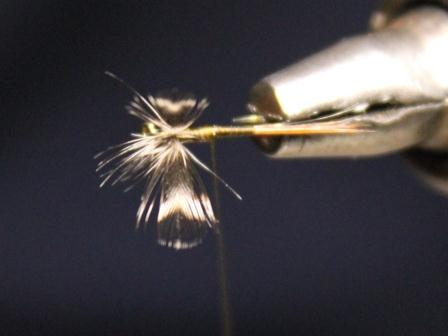
Tie in the wings, tips forward
 Now stand the wings up with a few wraps of thread


Add a tail using brown and grizzly feathers
 Your fly should look about like this from above


 Add a fine bead of muskrat dubbing from the tail up to the wings

 Wrap both Grizzly and Brown #20 saddle hackles forward past the wings and complete the fly with a whip finish.


This #20 Adam's dry fly is very effective in the Spring and Fall on the Colorado River, Roaring Fork River and Frying Pan River.  For a Fly Fishing Guide in the Aspen, CO area any time of the year, go to http://www.aspenflyfishing.com


"How to tie a
 #20 Adams Dry Fly"