Showing posts with label dry flies. Show all posts

How to tie an H & L Variant Dry Fly


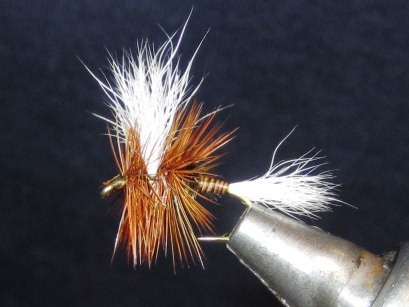
The H and L Variant is one of the great dry fly attractor patterns. This highly visible dry fly floats well, can be seen well in low light conditions and trout eat the heck out of it.  I like to use a size #10, #12, or #14 when tying this fly. I find that an H and L works best in fast rivers when there are lots of caddis and mayflies hatching, or anywhere on the Frying Pan River.


Watch how to tie this fly:

~ Click on any image to enlarge ~

Materials List:

You can expect this H&L to get lots of bites.  I suggest using a strong dry fly hook that won't bend out.


I like to use a thread that is strong, but not too bulky when I tie hair wing dry flies like this one.  Danville's FlyMaster is a good choice.


The wings of this dry fly pattern are tied with Calf Body Fur.  This material is very visible even in low light situations.


Both the body and the collar of this fly are tied with peacokc hurl.


Finally, the hackle of an H & L Variant is tied with a couple of stout brown saddle hackles.
Click here to buy Brown Saddle Hackles


~ Click on any image to enlarge ~

Step By Step: How to tie an H and L Variant Dry Fly

Set a strong dry fly hook in the vise.
Start the hook with thread and leave it at the midpoint of the shank.
Stack the tips of a clump of calf body fur and tie them in, tips forward for the wing of the fly.
Now part the calf body fur and separate the wings with thread. I use a figure 8 wrap and often a few wraps around each wing. Be sure not to use too much thread. Here is a view from the top of the top.
Tie in the tail of the fly by stacking another clump of calf body fur.
The body of this fly is tied by stripping a peacock hurl and wrapping it forward about 1/3rd of the way to the eye.
Next, wrap two or three turns of regular peacock hurl for the collar of the fly.
Finally, tie in two stout brown saddle hackles. Wrap the hackles both in front and behind the wings and complete the fly with a few tight whip finishes.

H and L Variant Dry Fly


Dry Fly fishing in Colorado is fantastic, especially around the Aspen area.  The rivers here are full of hungry trout that love to eat dries.  The best time of year to catch fish on dry flies is July, August and September.  If you would like to experience what dry fly fishing should be, go to http://www.aspenflyfishing.com and book a guided float trip.


How to tie an
H and L Variant Dry Fly

How to tie a #20 Adams Dry Fly


The Adam's Dry Fly is a great imitation of almost every adult mayfly. This well known pattern is a must for serious anglers in every mayfly hatch. My father always told me, "No brown trout in the world can resist a Size 20 Adam's..."


Watch how to tie this fly:


~ Click on any image to enlarge ~

Materials List:

If it is true that no brown trout can resist a #20 Adam's, then you better get a strong #20 hook.


I use some shade of gray when I tie this dry fly pattern. I have experimented with different colored threads, like yellow and olive, and they still eat it.


 The Adam's Dry Fly uses brown hackle in the tail and the hackle of the fly. I like to use saddle hackle because the feathers are dense and stout.


This little dry fly also uses grizzly hackle, combined with brown in the tail and hackle of the fly. Saddle hackle is still preferred here.
Click here to buy Grizzly Saddle Hackles


Finally, the last material is gray dubbing.  I use a tiny amount with each #20 Adam's Dry Fly.
Click here to buy Gray Dubbing


 ~ Click on any image to enlarge ~


Step By Step Instructions:  #20 Adam's Dry Fly


 Use a #20 hook
 Start with small gray fly tying thread
 Square up two Grizzly Hen Neck Feathers


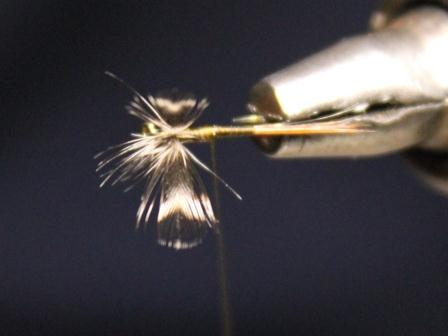
Tie in the wings, tips forward
 Now stand the wings up with a few wraps of thread


Add a tail using brown and grizzly feathers
 Your fly should look about like this from above


 Add a fine bead of muskrat dubbing from the tail up to the wings

 Wrap both Grizzly and Brown #20 saddle hackles forward past the wings and complete the fly with a whip finish.


This #20 Adam's dry fly is very effective in the Spring and Fall on the Colorado River, Roaring Fork River and Frying Pan River.  For a Fly Fishing Guide in the Aspen, CO area any time of the year, go to http://www.aspenflyfishing.com


"How to tie a
 #20 Adams Dry Fly"